NEP 2020 School Bag Policy: Transforming Education with Sweedu ERP
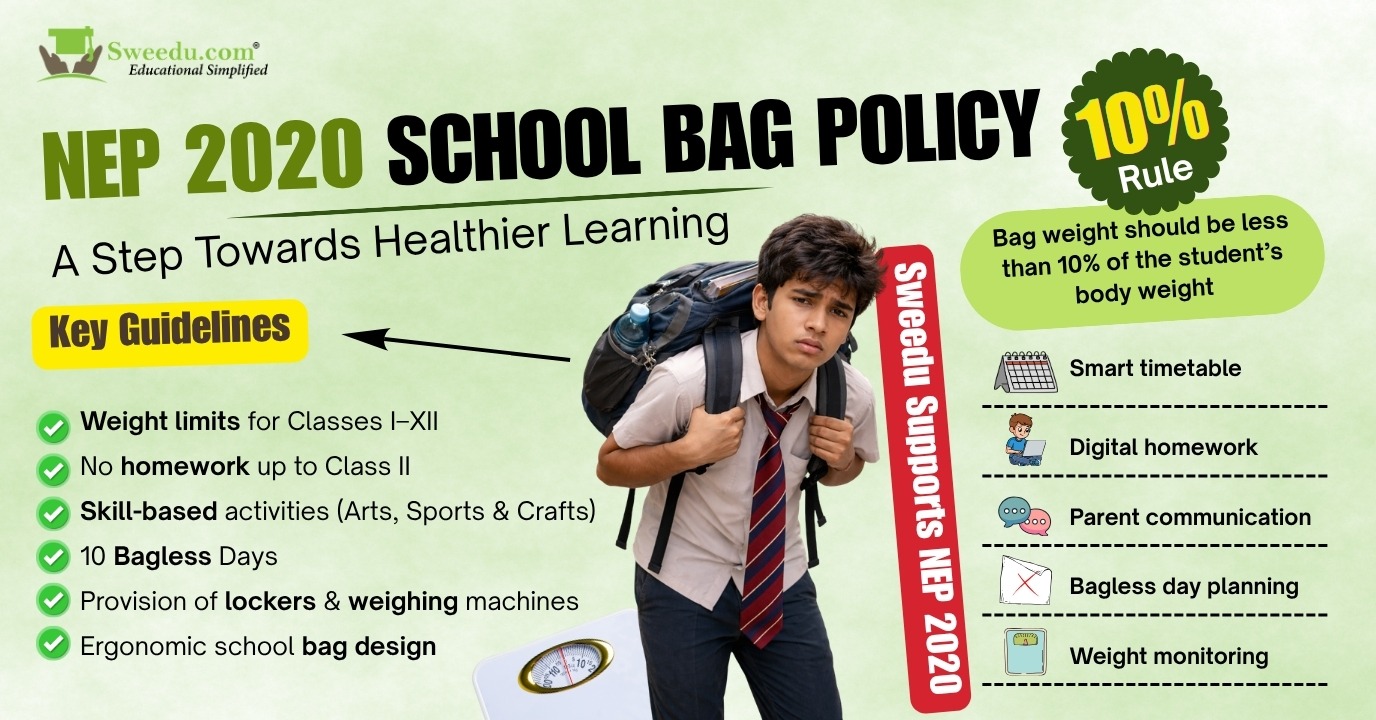
India’s education landscape is evolving rapidly under the National Education Policy 2020, focusing on reducing academic pressure and promoting holistic development. One of the most student-centric initiatives is the School Bag Policy 2020, introduced by NCERT and the Ministry of Education.
This policy is a major step toward ensuring stress-free learning, improved health, and better academic engagement for students.
What is the NEP 2020 School Bag Policy?
The School Bag Policy mandates that a student’s school bag should not exceed 10% of their body weight. It also introduces key reforms like bagless days, no homework for early classes, and structured academic planning.
The goal is simple:
👉 Reduce physical burden
👉 Promote joyful learning
👉 Encourage skill-based education
Key Highlights of School Bag Policy 2020
🎒 1. School Bag Weight Limit
To protect students’ health, the policy defines clear weight limits:
- Classes I–II: 1.6 – 2.2 kg
- Classes III–V: 1.7 – 2.5 kg
- Classes VI–VII: 2 – 3 kg
- Class VIII: 2.5 – 4 kg
- Classes IX–X: 2.5 – 4.5 kg
- Classes XI–XII: 3.5 – 5 kg
This ensures children are not overloaded during their formative years.
🚫 2. No Bags for Pre-Primary Students
Young learners are encouraged to focus on play-based and activity-based learning, eliminating the need for school bags entirely.
📚 3. No Homework Policy (Early Grades)
- No homework up to Class 2
- Limited homework for higher classes
This helps reduce unnecessary stress and improves learning quality.
🎨 4. Bagless Days for Skill Development
Schools must implement 10 bagless days annually, where students participate in:
- Vocational training
- Arts & crafts
- Sports and creative activities
This supports experiential learning, a core principle of NEP 2020.
🏫 5. Responsibilities of Schools
Schools are expected to:
- Provide lockers/storage facilities
- Use digital weighing systems
- Ensure lightweight books
- Plan efficient timetables
🎒 6. Ergonomic School Bag Design
Properly designed bags with padded straps and compartments help maintain correct posture and comfort.
Role of Sweedu ERP in Implementing NEP 2020
🔹 Smart Timetable Management
Sweedu ERP helps schools create optimized timetables, ensuring students carry only necessary books each day.
🔹 Digital Homework Management
With Sweedu School ERP Software, homework and assignments can be shared digitally, reducing dependency on physical books.
🔹 Parent-Teacher Communication
Real-time updates through Sweedu improve transparency and ensure parents are informed about daily academic requirements.
🔹 Bagless Day Planning
Easily schedule and manage bagless days, activities, and vocational sessions using Sweedu ERP.
🔹 Data-Driven School Management
Sweedu enables schools to monitor compliance with NEP 2020 policies and improve operational efficiency.
Why Schools Should Adopt Sweedu ERP
- ✅ Supports NEP 2020 implementation
- ✅ Reduces student burden
- ✅ Enhances digital learning
- ✅ Improves school efficiency
- ✅ Ensures transparency in operations
Conclusion
The NEP 2020 School Bag Policy is a powerful initiative aimed at creating a healthier and more engaging education system. By reducing the physical load on students and promoting skill-based learning, it paves the way for a brighter future.
With Sweedu ERP Software, schools can seamlessly align with NEP 2020 guidelines, ensuring better outcomes for students, teachers, and parents.
Light Bags, Bright Minds – Powered by Sweedu. ✨